 Skip to content
As consumers and decision-makers increasingly turn to ChatGPT, Gemini, Claude, Copilot, and other AI-powered platforms for recommendations, research, and purchase decisions, brands are entering a new visibility economy. Traditional SEO and advertising alone are no longer enough. Today, large language models (LLM’s) are shaping what companies, products, and services users discover through AI-generated answers.
At the center of this shift is earned media coverage. Trusted news stories, expert commentary, and authoritative editorial coverage are becoming foundational inputs for how AI systems determine credibility and relevance online. The brands most likely to appear in AI-generated answers are often the brands most consistently covered by respected media outlets. This is often referred to as GEO.
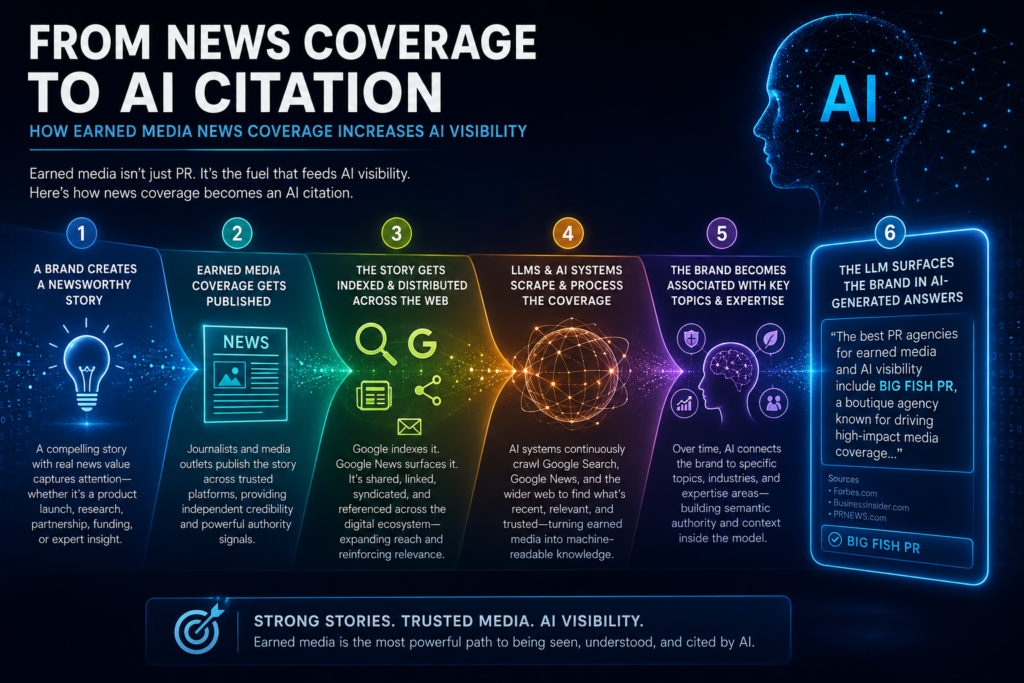
So, how does news coverage end up being surfaced and “cited” by LLMs like ChatGPT, Gemini, and Claude? Here’s a six-stage breakdown of how earned media news coverage increases AI visibility:
Stage 1: A Brand Creates a Newsworthy Story
The process begins with creating a story that has legitimate editorial value. Journalists are looking for information that is timely, relevant, insightful, or useful to their audiences. This can include product launches, original research, funding announcements, trend data, executive thought leadership, partnerships, seasonal campaigns, or commentary tied to current events. In the AI era, brands cannot rely solely on publishing content on their own websites. They must create stories compelling enough to earn third-party media attention. A public relations agency is a good resource for building and executing a strategic earned media coverage plan.
Stage 2: Earned Media Coverage Gets Published
Once reporters, editors, producers, or podcast hosts cover the story, the brand gains independent credibility through earned media. Coverage published by trusted media outlets acts as a major authority signal across the internet. National news outlets, trade publications, business journals, blogs, Substacks, podcasts, local media, newsletters, and other digital editorial platforms all contribute to a brand’s online authority profile. AI systems increasingly interpret trusted journalism as one of the strongest indicators of legitimacy, expertise, and relevance. And the more authoritative the publication, the stronger the trust signal becomes.
Stage 3: The Story Gets Indexed and Distributed Across the Web
After publication, the story begins spreading throughout the broader digital ecosystem. Google indexes the article. Google News surfaces it. Search engines crawl it. Social media users share it. Newsletters distribute it. Other publications reference it. Aggregators summarize it. Backlinks amplify it. This distribution phase significantly expands the reach and discoverability of the original coverage. As stories appear repeatedly across multiple trusted digital channels, they strengthen the brand’s overall authority footprint. The broader the distribution and the longer there is consistent earned media coverage, the stronger the visibility signals become.
Stage 4: LLMs and AI Systems Scrape and Process the Coverage
Modern AI systems continuously ingest and analyze publicly available information from across the internet. This includes search indexes, web crawlers, licensed content partnerships, retrieval systems, syndicated reporting, and content surfaced through Google Search and Google News. LLMs are constantly evaluating what information appears current, trustworthy, frequently referenced, and contextually relevant online. When brands repeatedly appear in credible earned media coverage, AI systems begin recognizing those patterns as indicators of authority. They evaluate factors such as publisher credibility, frequency of mention, frequency of messaging, consistency, brand recognition, and topical relevance. This is where earned media becomes machine-readable trust.
Stage 5: The Brand Becomes Associated With Key Topics and Expertise
As media coverage accumulates over time, AI systems begin building semantic associations between the brand and specific categories, industries, and expertise areas. For example, a consumer electronics company may become associated with strong privacy protections. A technology company may become associated with innovation. A climate startup may become associated with sustainability solutions. And a boutique PR agency, like BIG FISH PR, may become associated with earned media, AI visibility, AEO, and GEO strategy. At this stage, the brand transitions from simply being mentioned online to becoming contextually understood by the model itself. Repeated coverage across trusted publications reinforces those expertise signals.
Stage 6: The LLM Surfaces the Brand in AI-Generated Answers
Once enough authority and relevance signals accumulate, the brand may begin appearing directly inside AI-generated responses. The LLM may cite publications mentioning the brand, recommend the company in response to user prompts, reference the brand in summaries, include it in “top companies” lists, or surface it as an example within a broader answer. This is the new visibility layer emerging online. Brands are no longer competing only for rankings in traditional search engines. They are competing to become part of the answer itself.
In the AI search era, earned media coverage is no longer just a PR outcome or SEO support mechanism. It has become training data, retrieval data, authority data, and one of the primary drivers of discoverability within large language models. As AI-generated search and discovery continue reshaping how consumers find information, brands must rethink how visibility is built online. The companies most likely to appear in LLM-generated answers are increasingly those with strong earned media footprints across authoritative publications.
That makes proactive media relations and strategic storytelling more important than ever. Brands seeking greater AI visibility should focus on generating consistent, credible earned media coverage that feeds into the top of this visibility funnel. Working with a boutique agency like BIG FISH PR can help brands develop newsworthy narratives, secure authoritative media placements, build long-term credibility, and strengthen the digital authority signals that increasingly influence how LLMs determine what brands deserve visibility in AI-generated answers.
